Glossary
A
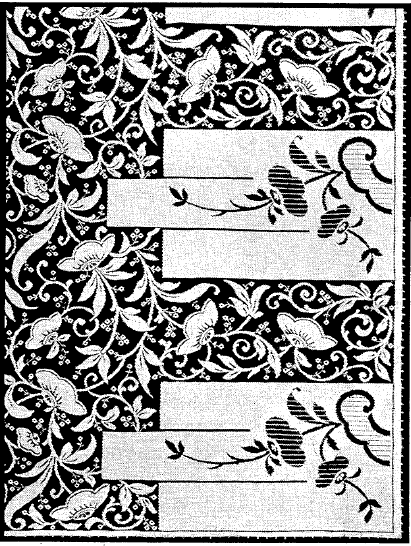
aetzing - Derived from the German for caustic. Refers to the process of dissolving away the background of an embroidered fabric. Only the embroidery stitches remain, thereby creating a lace. The work made this way is called aetzstickerei. See PLAUEN LACE.
Alençon/Needle Lace - A specific type of needle lace with a net background and motifs outlined with thicker thread (cordonnet). Also, a lacemaking center in Normandy, France, from the 17th century onward. The name is also associated with a light looped net. See also point d'Alencon.
application lace - Any lace in which the additional decorative pieces are attached to the surface of the machine net or bobbin reseau ground via needle and thread.
appliqué - The method of sewing ready-made lace motifs onto a pre-existing net or mesh fabric.
Argentan - A lacemaking center in Normandy, France, from the 17th century onward. The name is associated with heavy, hexagonal mesh grounds (brides bouclees and brides tortillees).
Argentella - An 18th-century needlepoint lace (usually regarded as a form of Argentan distinguished by its elaborate ground of solid hexagons within skeletal hexagons (reseau rosace).
aune - A french unit of measurement, corresponding to the English ell, that varies from about 39 to 48 in. (97.5 to 120 cm). The June is equal to 46.8 inches in Paris, 39.4 inches (the meter) in some parts of Europe, and formerly 47.2 inches in Belgium. This was one of the measuring units that fell into disuse when France adopted the metric system.
B
band work- A stitch used in needlepoint laces to fill centers with fancy openwork. Similar to Mode.
barb - A minute scale found on fur fibers.
blonde - Lace made of silk. In the 18th century the name was applied to a large group of bobbin laces made originally of undyed silk from Nanjing, China, but later it was used for any lace made of silk, leading to confusing terms like "black blonde." Blonde de Caen was a 19th-century version with threads of varying textures and colors and bold floral patterns with large open or colored areas in the centers of flowers.
bobbin - Handheld tool (usually elongated and made of wood or bone) used to manipulate the threads in bobbin lace by hand. Bobbins vary in size according to the quality and weight of the lace; the threads are wound around their center to provide tension.
bobbin lace (plaiting/twisting on a pillow) - is one of two techniques involved in handmade lace manufacturing. The other is needle (stitching with a needle).
bobbinet - Machine-made net that mimics hand-twisted net. After the invention of the bobbinet machine, the term was confined to machine-made net, which mimics handmade twist net. The bobbinet machine was invented by John Heathcoat in 1809 and is also called the "Old Loughborough."
braccio - Italian; an old unit of length used in Italy, usually about 26 or 27 inches (66 or 68 centimeters), but varying between 18 and 28 inches (46 and 71 centimeters). Plural: braccia.
brides(connecting bars/threads) - French; bars, bridges. Narrow bobbin- or needle-made threads linking the individual motifs of a lace design. Also used in describing the mesh grounds of French needle laces.
Brussels bobbin lace - A name especially associated with a fine 18th-century part lace grounded with Drochel net. See also point d'Angleterre and Rosaline.
Brussels Net - A net fabric with a hexagonal mesh. Synonym filet de bruxelles.
Burano lace - Lace made on the island of Burano, near Venice. Originally needlepoint lace of fine quality with net ground; ALENCON LACE, ARGENTAN LACE, and BRUSSELS LACE, along with others, are currently made there.
burn out fabric - A fabric or lace made with two different yarns with a pattern effect produced by destroying one of the yarns with a chemical wash or printing process that employs chemicals instead of color.
C
cage work - also known as openwork.
carrickmacross lace - An Irish lace made since about 1820 in the vicinity of Carrickmacross, Monaghan, in Northern Ireland. There are two types: (1) carrickmacross appliqué, in which the pattern is cut from fine cambric and sewn to a net background; and (2) carrickmacross guipure, which is more like an embroidery in which part of the cloth is cut away and the pattern joined by bars.
Chantilly Lace - Name for black silk bobbin laces produced in Chantilly, France, from the second half of the 18th century. Designs of flowers and flowing ribbons are made in half stitch for delicacy with untwisted cordonnet outlines on mesh fond chant (see point de Paris. In the 19th century Chantilly broadened to include cotton and linen fibers and could also be made by machine. It was especially desirable for shawls and mantillas. In this period, the black silk used was called grenadine.
chemical lace - A form of machine embroidery developed in the 1880s in which the pattern was worked in a vegetable fiber (usually cotton) on a silk ground; the latter was then burnt out or dissolved with caustic soda or chlorine. Today chemical lace is made from many other combinations of materials and the ground fabric can be dissolved with warm water. Key to production is a difference in the material of the ground fabric and the threads of the embroidery. It is generally used to produce imitation needle lace and crochet. French: metier suisse, dentelle suisse. See also guipure.
cloth stitch - A stitch in bobbin lace in which the threads are interlaced as in weaving. Synonyms: point de repasse, point de toile.
cordonnet - A heavier cotton yarn used to outline the motifs of patterns or designs. Used in lacemaking and for other decorative textiles.
curragh lace - A term often used as a synonym for IRISH POINT LACE. A school of lacemaking was established in Curragh County Kildare, eastern Ireland, during the 19th century. There, young women were taught how to crochet and to make lace.
cut work - An embroidery technique in which holes are cut in linen, embroidered with thread, and decorated with buttonhole-stitch bars. Often considered the precursor to true needle lace. 16th century. French: point coupe. German: aussgeschnittene Arbeit, Ausschneidestickerei. Italian: punto tagliato.
D
dentelle - (1). A French term for scalloped edging. (2). A term used in France for lace since the 17th century. Before then the term passement was used commonly.
drawn-thread work - Selected warp or weft threads are drawn out and cut off, the raw edges stitched over, and the remaining threads decorated with buttonhole or other stitches in a variety of designs. Extensive use of this technique could result in cutwork, and it is sometimes combined with pulled-fabric work. Requires a tightly woven fabric. Italian: punto tirato.
Drochel - A bobbinet ground most commonly associated with 18th-century Brussels bobbin lace and made without pins except along the outer edges. It is a hexagonal mesh with two sides of four threads plaited four times and four sides of two threads twisted twice. The name is thought to have derived from the Flemish word Draadsel, meaning "mesh of threads." Also called Droschel, drossel, vrai reseau and Flemish reseau.
E
edelweiss lace - Synonym for aetzstickerei. See AETZING.
ell - An old measure of length often used for textiles. Equivalent in England to about 45 inches (114.3 centimeters); in Scotland, 37 inches (94 centimeters); in Belgium, 27 inches (68.6 centimeters); in France, 54 inches (137.2 centimeters; the aune.
embroidered lace - Production of ornamental embroider effects on a pre-existing ground of lace fabric.
engageantes - French; the gathered and shaped ruffles of lace or muslin that were attached to women's sleeve cuffs in the late 17th and 18th centuries.
entretoile - French; openwork created or lace inserted between two pieces of linen. Also known as insertion work or insertion lace.
F
falbala - French; a gathered piece of fabric used as a decorative edging. English: furbelows.
faldellin - Spanish; a wrapped A-line skirt with a side-front opening that became fashionable to use as an outer skirt among the women of the Viceroyalties of New Granada and Peru in the 18th century. An early 18th-century source describes it as having three rows of lace with the middle row of gold and silver.
filled cloth - A cloth -- usually cotton, silk, or wool -- to which filling has been added in the finishing process to close the spaces between yarns. This treatment improves the appearance of the fabric, making it look more closely woven, and increases the weight.
filling - Composite stitches used to form decorative patterns in the centers of both needle- and bobbin-lace motifs to fill space. They are essentially ornamental and usually varied, as opposed to the ground, which serves the practical purpose of holding the design in place and is of uniform appearance. French: jours, modes.
fond chant - A six-pointed, star-shaped ground net used in making bobbin lace.
furbelows - gathered, pleated, or puckered strips of fabric used as decorative trimmings -- such as flounces or ruffles -- on clothing, particularly petticoats or gowns.
G
gimp/gimpe - A thicker thread that outlines motifs to create a raised effect.
grenadine - (1). A twisted cord that is composed of a number of strands that are twisted individually. (2). A fine, stout, hard twist silk yarn used in hosiery and laces. (3). A table linen damask made in France. (4). A black silk lace worn in France during the 18th century.
gros point- An Italian needlepoint lace with a heavy, raised design forming a horizontal scroll, comparatively simple bars, and usually a straight edge, trimmed only with picots. The design is padded and buttonholed along one edge. Widely used during the second quarter of the 17th century. Synonym: gros point de venise. See PICOT.
ground - machine-made technique for lace manufacturing. This is the background mesh of a manufactured lace design.
Guipure - A heavy lace with no net background, featuring thick motifs connected by brides.
H
half stitch - (1). Loose, open stitch used in pillow laces. Not to be confused with CLOTH STITCH. (2). In knitting or crocheting, two stitches taken as one to contract the edge.
hand-embroidery machine - A hand-guided embroidery machine that initially could produce several identical satin-stitched designs simultaneously. It was the predecessor to the Schiffli machine and was invented in France in 1828 by Josue Heilmann.
Honiton lace - A term for bobbin lace of the Brussels type in Devonshire and parts of Dorset, Somerset, and Wiltshire, United Kingdom. 18th-20th century.
I
imitation lace - A term sometimes used in the past for machine-made lace; handmade lace at that time was considered the only true lace.
insertion lace - A narrow lace or embroidery with a plain edge on both sides that permits it to be inserted in a fabric.
Irish lace - General term for lace made in Ireland. The most familiar Irish lace is of the crochet and needlepoint types, including CARRICKMACROSS LACE, CURRAGH LACE, IRISH CROCHET LACE, and LIMERICK LACE. Early Irish laces were cutwork and drawn thread work. Also see RENAISSANCE LACE.
Irish crochet lace - A crochet lace introduced in Ireland about 1820. It is distinguished by the crochet stitch; the ground is made of square mesh with or without PICOTS and the design is usually roses or leaves, resembling the patterns of the needlepoint laces of Spain and Venice. Synonyms: crochet point, Irish lace, jesuit lace.
J
jabot - French; a decorative ruffle attached to the front opening on a man's shirt. 17th-18th century.
jours - Open stitches used as fillings in making lace. Synonyms: a jour, mode.
K
knotted lace - A type of lace made by tying lengths of thread into knots by hand, the knots forming the patterns. MACRAME and TATTING are the two types of knotted lace.
L
lace - Originally a term meaning a narrow tape or braid. By the late 16th century, it had become the generic term for all forms of non woven, bobbin- and needle-made openwork. Dutch: Kant. French: dentelle. German: Spitze. Italian: pizzo, merletto. Spanish: encaje.
lace furnishing machine - A lace machine in which yarns are wound on brass bobbins that are placed in carriages and move across an allotted comb space. The bobbins swing between vertical warp and pattern yarns, moving at right angles to the warp. Guide bars control the lateral movements of the warp and pattern yarns, A spring steel wire with a point (jack) can enter between the warp and pattern yarns to modify their lateral movements to create a pattern. The jack bar, into which a number of jacks (jack leads) are set, together with a jacquard, controls the pattern. Synonym: curtain machine.
lappets - Two strips of lace or linen hanging from the back or sides of a woman's cap. Popular in the late 17th and 18th centuries and again in the middle of the 19th century. Also called barbes (French), pinners and streamers.
lead works - See Mode.
Leavers machine - A versatile variant of the 1809 bobbinet machine. Because it held more bobbins in a single row, it was able to make patterned laces more easily and did not need to traverse the net. It was invented in 1813 by John Levers in the United Kingdom.
Lille - A lacemaking center in northern France that primarily produced lace of the Mechlin and Valenciennes types, though it is now associated with a fine twist net ground decorated with delicate, thin patterns.
limerick lace - An Irish lace originally only made in Limerick. The industry was established at Mt. Kennet, Limerick, by Charles Walker in 1820. Many women skilled in making this lace emigrated to the U.S. in the 1860s. There are two types: RUN LACE and TAMBOUR LACE. Also see NOTTINGHAM LACE.
M
macrame - (1). The art of knotting string, cord, wool, or other yarns and arranging these knots in different sequences to create various and attractive designs. Knots can be spaced to form an openwork pattern or placed close together for a denser look. Term derived from the Arabi word, migramah, meaning embroidered veil. Articles made from macrame include clothing and accessories, wall hangings and plant hangers. (2). See KNOTTED LACE.
Mechlin - A delicate bobbin lace with patterns outlined in heavier, but fine thread. FOND DE NEIGE or simple net ground with hexagonal mesh made with plaited sides is employed. The patterns are predominantly dainty floral designs. All laces produced in Flanders prior to about 1665 were called maline, with the exception of the old brussels point. Also see NEEDLEPOINT LACE. Mechlin is the Flemish name for the Belgian town of Malines where this lace originated and by which name it also is known. Sometimes it is referred to as broderick de marines because of the outlining of the design, which resembles embroidery.
merletto - An Italian term for lace.
mode - Any filling-in stitch in lace. Synonyms: band work, filling, jours, lead works.
motif (main pattern) - these patterns can be geometric (linear, circular, square, diamond, ovals, etc.) floral (roses, peonies, sunflowers, daisies, etc.), figural (cherubs, angels, griffins, animals), and/or scenic (courting couples, couples dancing, hunting scenes, ships and seas, etc.).
N
needle lace (stitching with a needle) - is one of two techniques involved in handmade lace manufacturing. The other is bobbin(plaiting/twisting on a pillow).
needlepoint lace - One of the two chief types of handmade lace (the other being bobbin lace). Needlepoint lace is created with a needle and threads. A design is drawn on heavy paper. Linen or cotton thread is used to outline the design and this thread is attached to the paper by tiny stitches. The various parts of the design are interconnected by threads and all of the threads are worked over with buttonhole stitches. Tiny loops or picots usually are made along the edges of the motifs that make up the design and along the bars that connect the different parts of the pattern. When completed, the stitches that connect the lace to the paper backing are cut, thereby freeing the piece of lace.
needle-run lace - A lace made on a net ground; made entirely by machine or with machine net ground only. The pattern is outlined with a heavier thread run by hand.
Nottingham lace - 1. A wide cotton lace made on the LACE FURNISHING MACHINE in a mosaic-like pattern with a "V" design. Used for curtains. 2. Originally, any machine-made lace produced in Nottingham England.
O
open work - In embroidery, laces, knitting, and crocheting, interstices in a ground of closer texture, often to form or enhance a pattern. Synonym: cage work.
oriental lace - 1. A general term for lace made in China, Japan, India, Turkey, and Iran. 2. An embroidered lace in which the foundation is either cut out or burned out with chemicals. Made on an embroidery machine. Used for curtains, dresses, trimming. See PLAUEN LACE.
P
part lace - Any bobbin lace in which the individual motifs or sections of the pattern or toile are made separately and joined by hooking or by bars or a mesh ground. Also called noncontinuous lace.
picks
picots - (1). A series of small loops along the edge of a fabric made in the loom by placing a cord or wire parallel to the edge of the fabric to catch certain filling yarns. The cord is removed after the fabric is woven, leaving the row of loops. (2). A small decorative loop. Often found on the edges of ribbon and LACE and on pattern elements within lace and often added to the edges of brides or motifs.
plauen lace - Lace that is created by embroidering designs by hand or machine on a muslin, net, or other fabric ground. After the embroidery is complete, the fabric is treated with chemicals that destroy the fibers of the ground fabric, but not the lace-like embroidery. The name is derived from the city of Plauen, Germany where a good deal of this lace has been made. See BURN-OUT FABRIC, SAINT GALL LACE.
point coupe - A French term for CUTWORK.
point d'Alencon - See ALENCON LACE.
point d'Angleterre - French; "English stitch," though it has no connection to England. A very fine noncontinuous bobbin lace (see part lace), occasionally with needlepoint fillings or motifs, made in Brussels from the mid-17th to late 18th centuries. The earlier floral designs were similar to the gros points with crowded hexagonal Drochel grounds. In the late 19th century the term referred to a Belgian lace made of fine-quality bobbin sprigs linked by a point de gaze ground and with delicate needle-made fillings.
point de gaze
point de neige
point de paris
pricking/pattern - A paper design with holes pinned to a pillow, guiding where the bobbin lace worker moves the threads.
pulled-fabric work - A technique in which the threads of a woven fabric are pulled and stitched together to form decorative holes in an openwork pattern. It does not entail cutting or removing threads and requires a loosely woven fabric. Distinct from (but often combined with) drawn-thread work.
punto tagliato
punto tirato
Q
quesquemiel - Spanish: an Indigenous Mexican garment worn by the Nahuatl elite in pre-Hispanic times. The triangular form consists of a cloth with a neck hole cut in the center that is pulled on over the head and usually falls to a point in front and back. It was worn by noblewomen and priestesses in ceremonies and used over a huipil. From Nahuatl quechquemitl.
R
rayon
Renaissance lace
réseau
reticella - Italian; "little net." A geometric cutwork technique of the late 16th century in which large squares of woven linen are removed and the edges are covered in buttonhole stitches; it also refers to needle lace built up on a ground of laid threads (pinto in aria). A precursor to true lace. (Quaker Lace Pattern No. 4800 - Florentine)
rosaline:
- Italian; a term for English point de neige, often used for later Burano lace rather than for the 17th-century Venetian styles;
- Rose point, which is a 19th-century name for medium-sized raised Venetian needle lace of the 17th century (gros point being the largest and point de neige the smallest;
- Brussels point de gaze;
- A late 19th-century Brussels bobbin lace with crinkly edges to the motifs and a suggestion of button roses in the design;
- A late 19th or 20th-century Italian bobbin lace with boldly curling stems terminating in half-stitch buds, associated today with the town of Cantu. Also spelled "roselline."
rubato
run lace - A lace with patterns made either by embroidering with darning stitches or by machine-made chain stitches. The run lace generally is finer and lighter than TAMBOUR LACE because it is run in with a needle, not drawn in with a hook. The lace came into vogue after the Nottingham machine net had made the work possible, and sometimes is known as NOTTINGHAM LACE. See LIMERICK LACE.
S
Saint Gall Lace - A general term applied to laces and embroideries produced St. Gall, Switzerland. Specifically, a Swiss embroidered lace made in imitation of venetian and other laces. The SCHIFFLI machine or another embroidery machine is employed on a net, muslin, or other ground which is later burnt out. TAMBOUR work is also produced, and Swiss BRUSSELS LACE has been a popular product in St. Gall. Synonyms: edelweiss lace, embroidered lace, SAXONY LACE, swiss lace. Later called plauen lace, when the development of the SCHIFFLI machine at Plauen, in Saxony, Germany, made it famous in the markets of the world.
Saxony lace
Saya - Spanish; a two-piece ensemble worn by Spanish women in the 16th and 17th centuries that included a cone-shaped overskirt (basquina) and a bodice (curea). In some later contexts, it simply denotes the skirt of the ensemble.
Schiffli machine - An embroidery machine invented by Isaak Grobli in Switzerland in 1863 that applied the shuttle, continuous thread, and lock-stitch innovations of the sewing machine to embroidery. Until this point, such machines could work only with short lengths of thread. It can reproduce the same design many times over at once and imitate the patterns of needle-run laces. The design was originally controlled by a pantograph: as the course of the threads was traced stitch by stitch on a master design, the net itself was moved and the hundreds of needles embroidered in tandem along the width of the textile.
selvage
shed
shuttle
spitze
straight lace
streamers
Swiss Brussels lace
Swiss Lace
T
tambour hook
tambour lace - A piece of Nottingham or BRUSSELS NET is stretched on a frame and the decorative yarn is drawn through the meshes of the net with a TAMBOUR HOOK. Tambour work is of Eastern origin and the term tambour is derived from the drum or tambourine-shaped form on which the work is done. In the strictest sense of the word, it is not lace, but embroidery. May be made either by hand or machine. See LIMERICK LACE, NOTTINGHAM LACE.
tambour work
tatting
toile - The main, denser pattern section of the lace.
true needle lace
twist net
U
underpropper - The metal wire or pasteboard under-support for a ruff or other standing linen collar. Also called a supportable or rubato. 16th-17th century.
V
Valenciennes - Bobbin lace where the pattern and the ground are made at the same time.
A lacemaking center in territory contested between the Southern Netherlands and France (from 1678, part of France). In the 18th century Valenciennes referred to a high-quality straight lace in which clearly defined patterns are grounded with a round or square plaited mesh. In the 19th century it evolved to include extensive fil coupe and fil attache techniques to create lace of variable quality with exceptionally dense, white patterns and a square mesh. It is related to Binche and Mechlin laces.
Venetian lace
viscose process - One of the methods of producing rayon (also the chemical process used in the manufacture of cellophane). Process was invented by Cross and Bevan in England in 1892, but its successful operation was dependent on the invention there of the centrifugal pot spinning method by Topham.
vrai
W
wadstena lace - A Swedish peasant bobbin lace made in black or white; the designs are subject to changing styles.
warp - 1. A yarn (end) that runs lengthwise in a woven fabric, parallel to the selvages. Warp ends interlace with the filling yarns (picks) in different patterns to form different weaves. Warp ends are held in parallel and under tension in the loom and certain ones are raised or depressed, to form the SHED, before the insertion of each pick. The warp yarn can be of the same size as the filling or of higher of lower count. However, warp yarns are made stronger and placed closer together than filling yarns.
weft(filling) - 1. In woven fabric, yarn that runs from selvage to selvage at right angles to the warp. In the United Kingdom, the terms weft or woof are used instead of filling. Each yarn of the filling is called a pick, shoot, shot, or shute. 2. A yarn to be used as filling in weaving. 3. Any material added to fabric to increase weight or close up spaces between yarn to improve appearance. See FILLED CLOTH, WEIGHTING. 4. See MODE 1.
weighting
X
xanthating - An intermediate step in the manufacture of rayon by the viscose process. Alkali cellulose is treated with carbon disulfide for several hours at specified temperatures to convert it into cellulose xanthate.
Y
yarn - A continuous strand of textile fibers that may be composed of endless filaments or shorter fibers twisted or otherwise held together. Yarns may be single or ply and form the basic elements for cabled yarn, fabric, thread and twine.
Z
zante lace - A RETICELLA LACE originally, and currently made in Zante and other Ionian island off the west coast of Greece.